
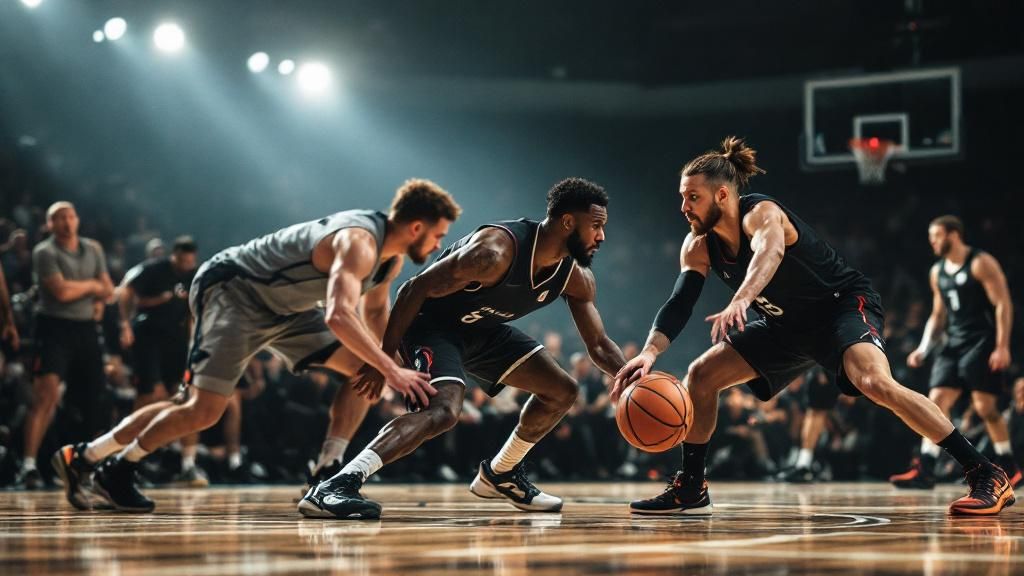
The pick-and-roll remains one of basketball’s deadliest offensive weapon, yet only the world-class point guards fully command its complex nuances. From Stephen Curry’s exceptional spacing to Luka Dončić’s resourceful finishing, the elite performers orchestrate this essential play with exceptional sophistication. This article explores the elite strategies that set apart elite orchestrators from the competition, investigating how elite point guards manipulate defences, generate scoring chances, and maintain competitive dominance through mastered pick and roll execution at the highest level.
Understanding the Core Principles of Pick-and-Roll Play Proficiency
The screen and roll exemplifies basketball’s most fundamental yet profoundly effective attacking play, functioning as the bedrock of contemporary offensive strategy at elite levels. Developing proficiency in this partnership play requires exceptional understanding of positioning, timing, and defensive recognition. Top ball-handlers recognise that effective implementation transcends basic technical repetition; it requires sophisticated reading of defensive positioning and split-second decision-making. The most skilled exponents utilise the screen and roll not simply as a scoring mechanism, but as a versatile tool for creating benefits that ripple throughout entire offensive systems, producing further openings for teammates and prompting defensive adjustments that uncover defensive gaps.
Championship-calibre point guards set themselves apart through their ability to manipulate pick and roll elements with exceptional accuracy and inventiveness. They recognise that screen angles, roll timing, and decision-making speed critically shape outcomes against sophisticated defensive schemes. Understanding defensive coverages—whether switching, hedging, or blitzing—allows elite playmakers to predict how opponents will respond and exploit gaps accordingly. The foundation of excellence lies in acknowledging that the pick and roll’s true power emerges from combining technical proficiency with basketball intelligence, enabling point guards to direct offensive play with authority and consistently generate high-percentage scoring opportunities that maintain a winning edge throughout challenging campaigns.
Perfecting Spacing and Positioning Techniques
Elite point guards recognise that spacing and positioning form the basis of successful pick and roll execution. By preserving proper spacing from teammates and the ball handler, guards open up passing lanes that defences cannot adequately cover. The most skilled playmakers position themselves to take advantage of defensive gaps, forcing defenders into difficult positioning. This strategic awareness allows them to anticipate defensive shifts milliseconds faster than their opponents, enabling sharp decision-making that sets apart elite performers from solid players in high-pressure competitive environments.
Positioning goes beyond basic floor positioning; it encompasses anticipating defensive movements and adjusting accordingly. Elite point guards continually analyse spatial positioning, recognising how their positioning affects player options and points-scoring possibilities. By orchestrating subtle movements and keeping track of all five defenders, elite guards control court spacing to create advantageous matchups. This advanced strategy to positioning elevates the pick and roll from straightforward offensive movement into a powerful tool, allowing squads to regularly produce quality offensive looks against even the toughest defensive schemes.
Advanced Decision Making and Reading Defences
Elite point guards demonstrate outstanding ability to read defences during pick and roll execution. These maestros immediately recognise whether defenders use switching, aggressive blitzing, or coverage adjustments, then capitalise on weaknesses with pinpoint accuracy. By analysing defensive tendencies in advance and processing real-time adjustments, elite playmakers consistently locate available teammates or generate favourable scoring opportunities. This mental processing occurs in milliseconds, converting the pick and roll play into a chess match where better decision-making prevails over opposing schemes.
The most skilled point guards create sophisticated trigger mechanisms for choices within pick-and-roll scenarios. Rather than predetermined actions, they utilise subtle environmental cues—defender positioning, player spacing, and help rotation timing—to identify ideal solutions. Recognising when to drive to the basket, when to hit the roller, or when to reset and initiate secondary actions sets apart transcendent playmakers from solid players. This adaptability frustrates opposing defences, as their game plans grow stale against genuinely elite creators who constantly evolve their adjustments.
Mastering complex pick and roll techniques ultimately necessitates building basketball’s premier intellectual requirement: analysing defensive strategies with natural exactness. Championship point guards translate momentary insights into title-clinching actions through consistent preparation, video analysis, and competitive experience. This synthesis of technical excellence, physical capability, and cognitive sharpness characterises top-tier performance, enabling floor operators to continually outwit opponents and provide ongoing winning results at basketball’s highest echelons.
